Books appointments and consultations
It offers the open slots, holds the chosen one, confirms with the patient and updates the schedule. Rescheduling and cancellations follow the same path.
It books the appointment, confirms the time, reschedules whoever needs it and answers the patient at eleven at night. Then, at the end of the day, it reports back to you: who booked, who canceled, who was a no-show and what is still open.
Conversations run on Meta's official WhatsApp, through text, audio and images. Your front desk can step in whenever it wants.
The message arrives while the receptionist is helping someone at the counter. The patient asks again, gets no answer, and disappears. The next day they miss the appointment and nobody noticed. A decision-tree chatbot doesn't fix that: it replies to the patient, but it does nothing for the operation.
This is not a chatbot with a flow. It is an operational agent trained to work.
Patients write whenever it works for them. The virtual receptionist answers within the minute, with your clinic's context — specialties, accepted insurance plans, payment options and everything published on your website.
It offers the open slots, holds the chosen one, confirms with the patient and updates the schedule. Rescheduling and cancellations follow the same path.
A reminder 24 hours ahead and a confirmation on the day. It is the work nobody at the front desk has time for, and the work that keeps your no-show rate down.
Procedures offered, insurance plans accepted, payment options, address and opening hours — using the information the clinic registered.
It spots the sensitive case and transfers it to your team with the conversation history attached. The agent goes quiet in that chat until the person hands it back.
Older patients tend to send voice messages. It listens, understands and answers. It can also open the conversation with a short voice message introducing the clinic.
24 hours a day on Meta's official WhatsApp. Saturdays, Sundays and the lunch hour — which is exactly when most people get a chance to write.
The same agent recognizes the phone number of whoever runs the clinic and switches roles. You ask in plain English, on your own WhatsApp, without opening a dashboard.
The content depends on what each clinic configures in its agent.
Today's confirmations — 8 of the 24 slots
| Time | Patient | Appointment | Channel | State |
|---|---|---|---|---|
| 8:00 AM | Helena Prado | Consultation | Confirmed | |
| 8:40 AM | Otavio Ramos | Follow-up | Confirmed | |
| 9:20 AM | Bianca Sales | First visit | Awaiting reply | |
| 10:00 AM | Ivo Nogueira | Follow-up | Webchat | Reschedule |
| 10:40 AM | Celia Marques | Consultation | Confirmed | |
| 11:20 AM | Renato Bastos | Follow-up | No reply | |
| 1:30 PM | Amanda Vieira | First visit | Confirmed | |
| 2:10 PM | Sergio Lima | Follow-up | Phone | Canceled |
| 24 slots today = 17 confirmed + 6 pending + 1 canceled. The 6 pending are 2 awaiting a reply, 2 with no reply and 2 to reschedule. | ||||
Open reschedules — 2 open
Contact queue — 5 patients
It's the front desk's whole day on one screen: today's confirmation list, with every slot marked as confirmed, awaiting reply, no reply, to reschedule or canceled. Next to it sit the two open reschedules — with the slots the agent has already offered the patient — and the contact queue, which gathers everyone still waiting for an answer. Up top, the recurring task that fires tomorrow's reminders at 8:00 AM.
Nobody had to call twenty-four people to find out who is coming: the confirmations arrived through the conversation and turned themselves into a state on the list. What's left on the screen is exactly what needs a human decision — six open items and two reschedules — instead of all twenty-four rows. And when someone at the front desk takes over a chat, the agent goes quiet in that conversation and the amber banner records who stepped in.
Notice what the screen does not show: no clinical data. The columns are time, name, type of appointment, channel and state — no symptom, no history, no test result, because the default configuration does not touch medical records. Any link to a clinical system depends on a specific project and a contract, with purpose, legal basis and scope of access defined up front. And until the clinic's system is connected, the screen itself stamps the numbers as a simulation instead of pretending to be integrated.
Names, times and counts are fictitious. The same list the front desk sees here is what becomes the end-of-day summary on your WhatsApp — you only open the screen when you want the detail.
What changes from one clinic to the next isn't the technology: it's the agent's personality, the knowledge it consults and the tools it has at hand.
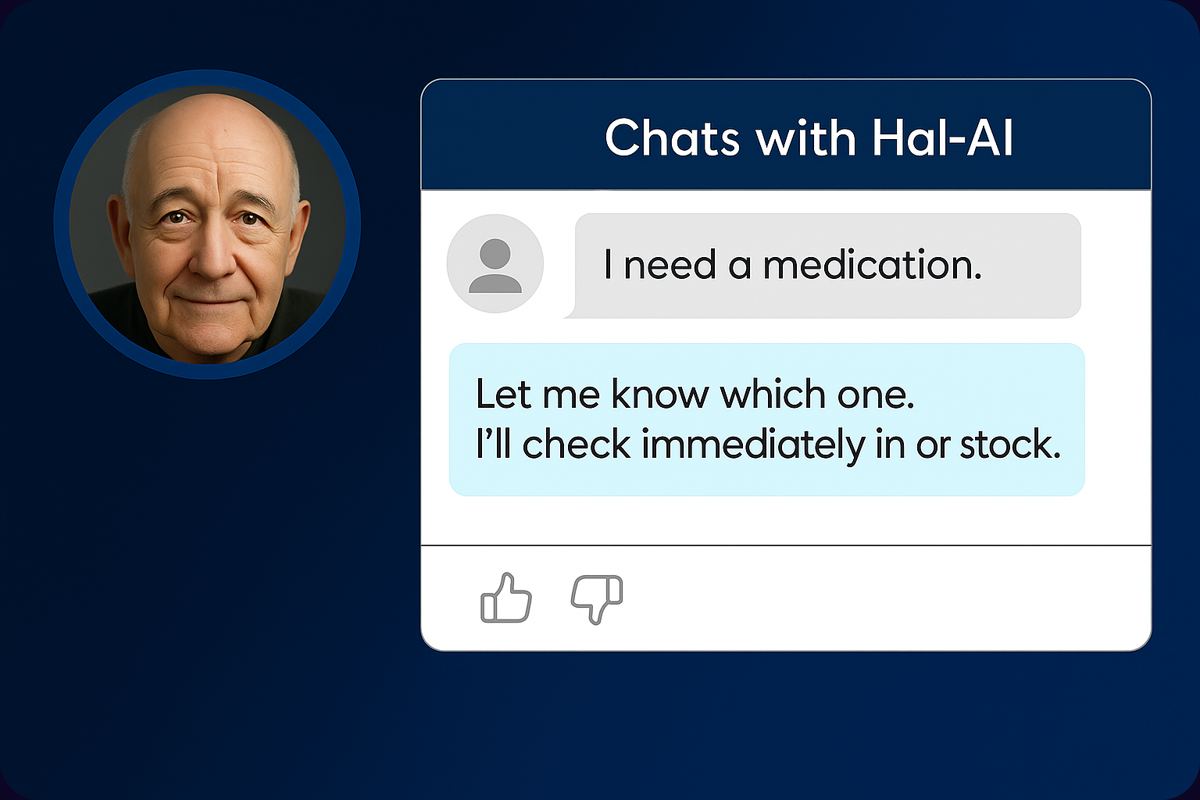
The agent is pre-trained on the clinic's website and rounded out by the Knowledge Vault: PDFs, text and images covering procedures, insurance plans and policies live in the base it consults before answering.
Your appointment book and clinic systems connect through APIs: the endpoint is registered once and becomes a tool the agent can use. The integration happens at activation, with the scope you define.
The patient on one side, you on the other. Same virtual receptionist, same phone number.
Pre-training starts with the clinic's own website. Whatever isn't there, you add.
The agent reads what you've published — specialties, procedures, address, hours — and starts out already able to talk about your operation.
Insurance plans accepted, payment options, rescheduling rules and the tone you want it to use with patients.
The number is activated through Meta's own authorization flow. Hal-AI is a Meta Business Partner and runs on the Official WhatsApp Business Cloud API.
You define which situations send a conversation to a person and who receives the end-of-day summary. Human takeover is available the whole time.
Healthcare demands clear boundaries. Better to say this before you sign than after.
The agent does not assess symptoms, suggest a diagnosis, recommend treatment or weigh in on medication. It handles the front desk: booking, confirming, rescheduling and sharing what the clinic has published. Anything clinical goes to the human team with the context of the conversation.
Medical records, clinical history and test results are sensitive personal data under Brazil's LGPD. The default configuration does not touch them. Any integration with a clinical system requires a dedicated project, with purpose, legal basis, access scope and responsibilities set out in a contract before any connection is made.
Until your clinic's system is connected, the agent states explicitly when an operational figure is a simulation. It never claims to be integrated with a system it isn't connected to.
No. It handles the front desk: booking, confirming, rescheduling and answering questions about hours, insurance plans, payment options and information the clinic has published. Anything clinical is passed to the human team.
Not by default. The initial setup works with what the clinic has published and with the appointment book. Access to a clinical system requires a dedicated project and a contract, with the purpose and LGPD legal basis agreed before any connection is made.
Yes. Hal-AI is a Meta Business Partner and runs on the Official WhatsApp Business Cloud API. The clinic's number is activated through Meta's own authorization flow.
It does. Human takeover lets a staff member step into any conversation; the agent goes quiet in that chat and the person picks up with the full history in view. The virtual receptionist takes the repetitive work off the front desk, not the decisions.
It understands them. The channel handles text, audio and images, and the agent can open a conversation with a short voice message introducing the clinic's services.
It does. A solo practice, a dental office, a small or midsize clinic — the more WhatsApp is your main channel, the more work it takes off your hands.
Turn on the virtual receptionist on your clinic's WhatsApp and watch the end-of-day summary arrive on your own phone.